Reviewed · TICKETS
Beijing: Confucius Temple and the Impercial College E-ticket
Beijing’s exam halls still feel serious today. If you like Chinese history tied to real stone details, this e-ticket is a smart way to see the Confucius Temple and Guozijian in one day. I especially love two things here: the carved imperial examination stone tablets at Confucius Temple, and the clear “temple on the left, college on the right” layout that makes the whole campus easy to understand. The main catch is simple: you will need your original passport or ID to use the ticket smoothly at entry.
Second, the visit works well because you can plan around three on-site exhibitions in the Temple area, instead of just wandering and hoping you catch the good stuff. One practical consideration is time, since the complexes are large, so wear comfortable shoes and expect a slow, respectful pace rather than a quick photo sprint.
In This Review
- Key highlights that matter
- Quick Entry With QR Code and Your Passport
- Temple on the Left, College on the Right: The Layout That Teaches You
- Confucius Temple: Yuan-Era Courtyards Built for Ritual
- Dacheng Hall and the Exhibitions You Can Use as a Guide
- Stone Tablets and the Imperial Examination: 51,624 Names in Rock
- Guozijian (Imperial College): Where State Education Took Shape
- How to Plan Your One-Day Walk Without Losing the Meaning
- Value for $7: Why This E-Ticket Feels Like a Deal
- Who Should Book This E-Ticket
- FAQ
- What is the duration of the e-ticket?
- How much does it cost?
- Where is the experience located?
- What do I need to bring for entry?
- Can I enter using a QR code and electronic ticket?
- What is included in the ticket?
- Is it possible to skip the ticket line?
- Is the attraction wheelchair accessible?
- Should you buy audio support on-site?
- Should You Book This Beijing Confucius Temple and Guozijian E-Ticket?
Key highlights that matter
- QR code + passport/ID entry keeps your start easy
- Yuan Dynasty architecture you can see firsthand, not just read about
- Confucius Temple ceremonies spanning Yuan, Ming, and Qing dynasties
- 51,624 Jinshi names carved into stone tablets, grouped and searchable by layout
- Guozijian, China’s state education system with gates, halls, and pavilions in classic symmetry
- Audio guide option at the Temple entrance if you want extra context
Quick Entry With QR Code and Your Passport
This is an e-ticket entry experience, and the process is refreshingly straightforward. Bring your original passport or ID card and use the QR code/e-ticket at the attraction entrance. The big win is that you can skip the ticket line, which is worth a lot in Beijing when queues can eat your morning.
Also, plan your arrival with the understanding that you’re using real document checks, not just a loose “show your screen” system. If you forget your passport or only have a photo, you will likely run into issues. I suggest you keep your passport or ID in a day bag you do not swap around once you arrive.
Finally, this ticket is listed as wheelchair accessible, and it’s offered as a private group format. Even if you are traveling independently, that usually means the experience is designed for smooth entry rather than chaotic roaming.
Beijing tours travelers are booking next

Temple on the Left, College on the Right: The Layout That Teaches You
One reason this pair of sites works so well together is the campus design. The Confucius Temple and Guozijian follow a formal rule: the temple sits on the left, and the college sits on the right. When you move along the main south-to-north axis, the buildings start to read like a lesson.
That means you can do two things at once:
- See impressive architecture.
- Understand how education and ritual connected in imperial China.
It also helps with navigation. You are not trying to stitch together random spots. You’re walking a designed path where gates, halls, and courtyards guide you from one major idea to the next.
Confucius Temple: Yuan-Era Courtyards Built for Ritual
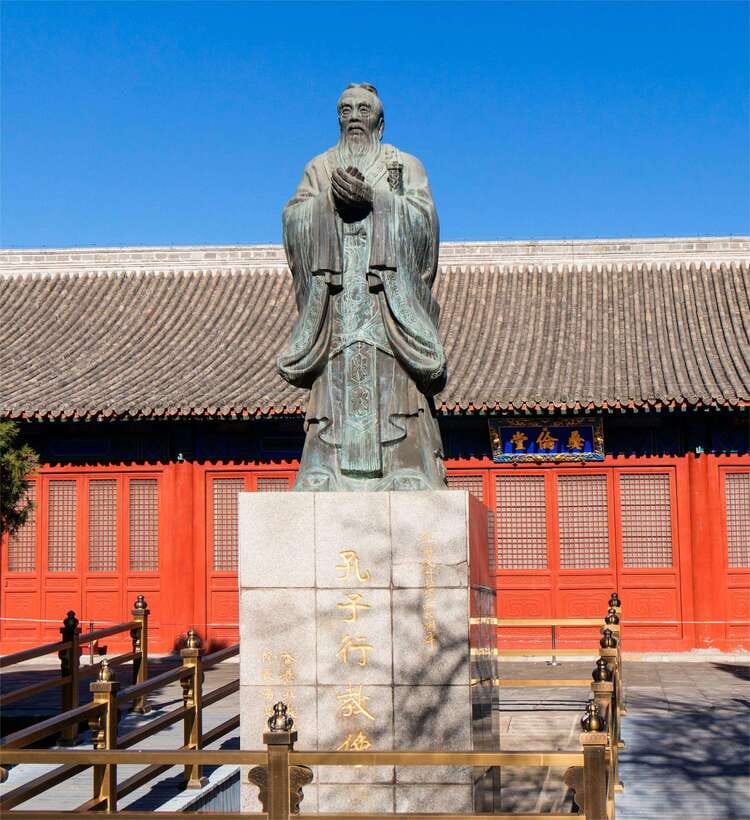
Beijing’s Confucius Temple dates to the Yuan Dynasty period, built in the 6th year of the Emperor Dade decade, which corresponds to 1306. What I like about this is that it was not a one-off building. It functioned as a ceremony site where memorial rituals for Confucius were held across Yuan, Ming, and Qing dynasties.
The scale is also meaningful. The temple complex covers over 22,000 square meters, with a construction area of about 7,400 square meters. You get three courtyards, and the experience is built around a clear sequence of spaces from the entrance toward the central ceremonial areas.
As you walk the main axis, look for these core elements:
- Teacher Gate
- Dacheng Gate
- Dacheng Hall
- Chong Sheng Temple
This is not just “see the buildings.” It is a ceremonial geography. If you slow down at each gate, you will feel how the design controls sight lines and movement, the same way imperial-era spaces were meant to shape behavior.
What to watch for: the Temple area includes a very structured feel. If you rush, you miss the point. Take the time to notice how each gate and hall changes the mood as you progress inward.
Dacheng Hall and the Exhibitions You Can Use as a Guide
The Confucius Temple area includes three exhibitions, and they are a practical way to focus your visit. Instead of trying to figure everything out on your own, you can pick the exhibit that matches your curiosity and let it steer your walking.
The exhibitions currently listed include:
- Exhibition of the Restored Dacheng Hall
- Exhibition of the Great Confucius
- Exhibition of the History of Beijing Confucius Temple
Here is how I’d use them. Start with the history exhibit if you want to understand why the Temple mattered in Beijing over time. Then use the Dacheng Hall restoration exhibit to connect the architecture to a specific centerpiece. Finally, the Great Confucius exhibit helps fill in the philosophical context without turning the day into a textbook.
One small tip from what people often do on-site: there is a chance to buy an audioguide at the Temple entrance. If you prefer listening over reading, it can be a good option, especially if you want your walk to keep moving.
Possible drawback: exhibitions can take time inside, and the complex is large. If you only have a tight schedule, choose one or two exhibitions and treat the rest as optional, rather than forcing all three.
Stone Tablets and the Imperial Examination: 51,624 Names in Rock
Now for the most memorable part for many people: the stone tablet collections.
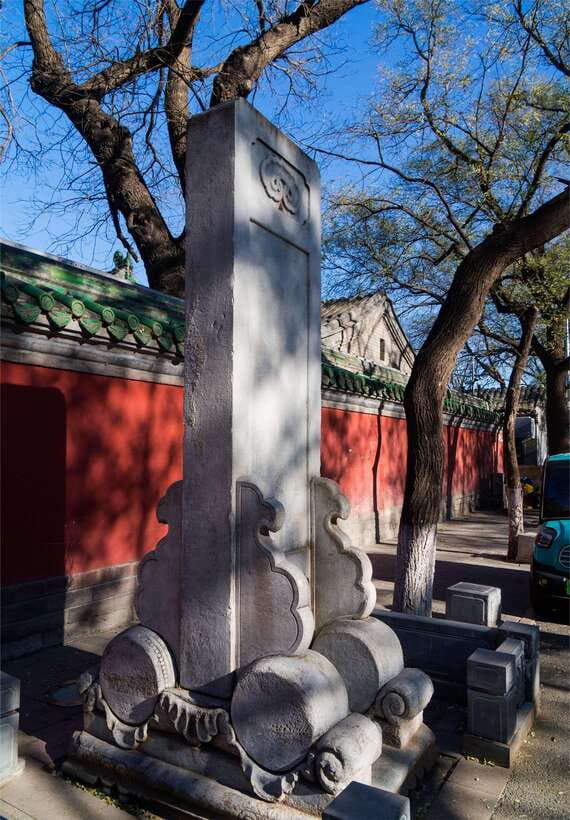
Confucius Temple has 198 stone tablets, arranged into four groups, located on both sides of the front courtyard. These tablets preserve an astonishing amount of detail, including 51,624 names, birthplaces, and ranks of Jinshi carved into stone.
Why it matters: this is not generic decoration. It is a physical record connected to the imperial examination system, the mechanism that shaped careers, scholarship, and status in the empire. If you care about how education becomes power, these tablets make the connection feel real.
When you are there, do not just scan. I recommend you pause and look at the way the tablets are grouped. The layout helps you understand that the collection is organized, not random.
Also note the information you can expect these tablets to support: research value and historical evidence about the exam system. Even if you do not read every character, the density of names alone gives you a clear sense of scale.
Travelers who read this also booked these.
- From Beijing: Mutianyu Great Wall Tours with Options★ 4.9 · 9,216 reviews
- Beijing: T-Square & Forbidden City Group or Private Tour★ 4.8 · 4,446 reviews
- All-Inclusive Tour: Tiananmen Square, Forbidden City, Great Wall★ 5.0 · 2,873 reviews
- MuBus: Mutianyu Great Wall ENG/ESP/RUS Guided Bus Tour★ 5.0 · 2,361 reviews
Guozijian (Imperial College): Where State Education Took Shape
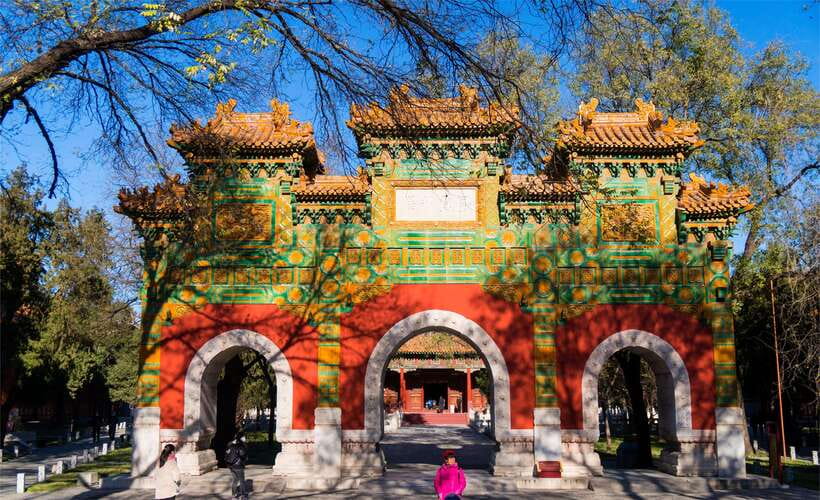
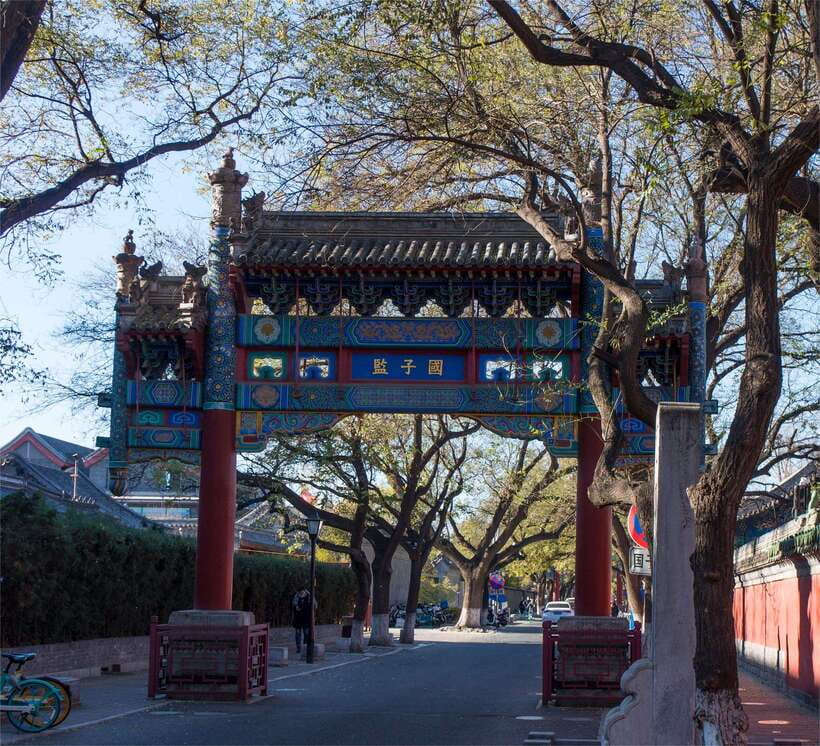
Guozijian in Beijing was the highest educational institution and the state’s governing body for education during the Yuan, Ming, and Qing dynasties. It is built in 1308, in the first year of the Zhida reign of the Yuan Dynasty. That puts it directly in the same broad Yuan-era construction world as the Confucius Temple, which is why pairing them in one day feels natural.
The complex covers about 28,000 square meters and includes three courtyards. Here again, symmetry and axis movement are doing real work. As you approach the central lines, you can see the official feel of a campus designed for governance, not just teaching.
Key structures on the central axes include:
- Jixian Gate
- Taixue Gate (Imperial College Gate)
- Glazed memorial Arch
- Biyong Hall
- Yilun Hall
- Jingyi Hall
Alongside these, there are also:
- Imperial tablet Pavilion
- Bell and Drum Pavilion
Guozijian includes two halls and six main rooms in the traditional layout. Even if you are not an architecture superfan, the campus design communicates its purpose quickly: this was the official pipeline for education and administrative credibility.
Practical note: because the Guozijian space is organized, your best strategy is not to zigzag. Follow the main axis, take short pauses at key gates and halls, then continue onward.
How to Plan Your One-Day Walk Without Losing the Meaning
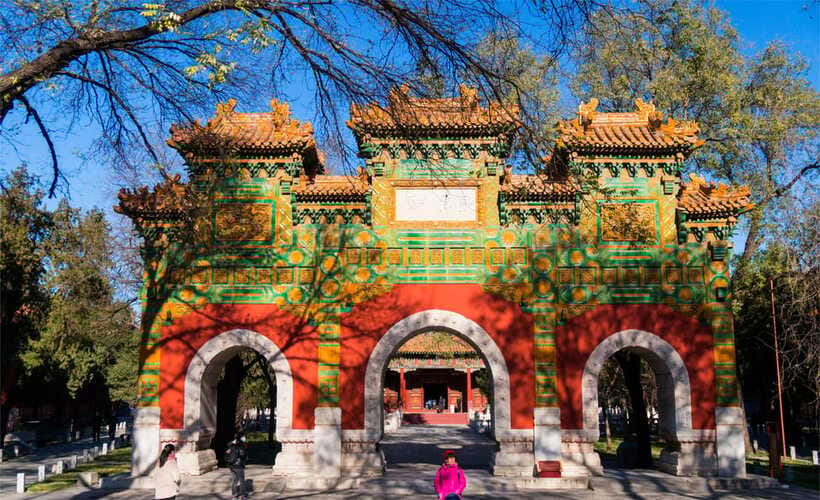
This ticket is valid for one day, so you can slow down and still finish. The trick is to give each complex a “role.”
I’d treat it like this:
- Confucius Temple first for ritual and the stone tablets.
- Then Guozijian for the education system and the state campus feeling.
A helpful way to pace yourself is to allocate time in three chunks:
- A quiet pass through the outer areas and gates (get oriented).
- The stone tablet area (your main “wow” stop).
- Exhibitions plus the Guozijian axis (finish with meaning).
If you love details, build extra time for reading and lingering around the tablet layout and exhibit content. If you are short on time, pick one exhibition and focus more on architecture and tablet placement.
Comfort matters. These are courtyard-heavy sites. You will do more walking than you might expect for a “single day ticket,” so plan for it like you would a half-day city walk, not like a quick museum drop-in.
Value for $7: Why This E-Ticket Feels Like a Deal
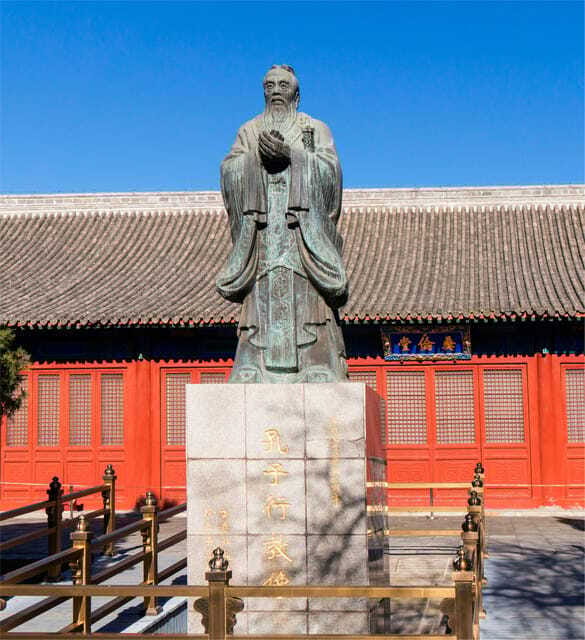
Price is where this really makes sense. At $7 per person, you are paying for entry into two major imperial-era complexes plus exhibition spaces in the Confucius Temple area.
You are not just buying access to one building. You are getting:
- A Yuan-built Confucius Temple complex with three courtyards
- A major stone tablet collection linked to the imperial examination
- Guozijian, the high-level state education institution
- A formal campus layout you can follow logically
That kind of “two sites, one day” structure is why the value feels real rather than theoretical. Even if you only spend moderate time inside, the exterior architecture and ceremonial geometry do a lot of the teaching for you.
One consideration: you still need to spend attention. If you want a fully guided narrative with a live guide speaking the whole time, this is not that style. It is more of a self-directed entry experience, with exhibitions and optional audio support helping you fill in context.
Who Should Book This E-Ticket
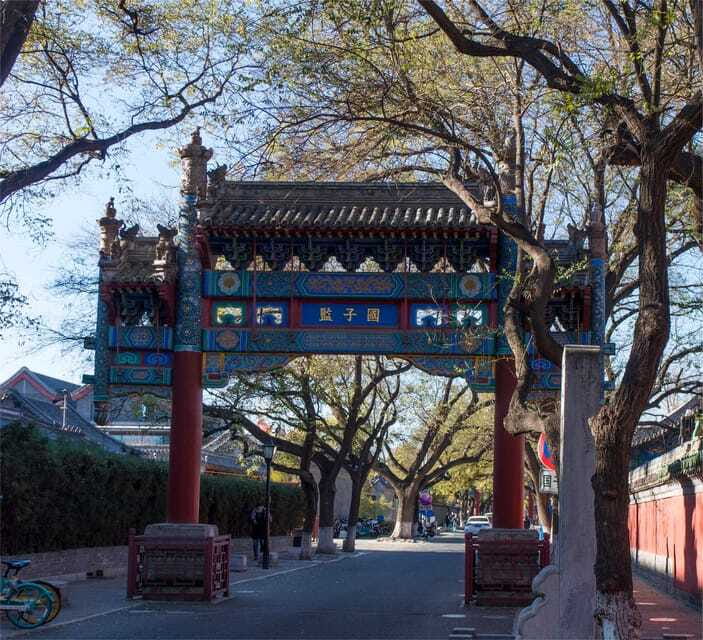
This experience is a strong match for you if:
- You like history tied to institutions, not just monuments
- You want to understand how education and ritual operated together
- You enjoy reading material anchored in physical objects, like the carved tablet record
- You want a low-cost day plan in Beijing that does not feel random
You might also like it if you are the kind of visitor who appreciates symmetry, courtyards, and axis-based layouts. The site design makes it easier to enjoy even when you do not speak much Chinese.
If you hate walking and you want only fast in-and-out photo stops, you may find it slower than you expect. Give it time, and it will reward you.
FAQ
What is the duration of the e-ticket?
The ticket is valid for 1 day.
How much does it cost?
The listed price is $7 per person.
Where is the experience located?
It is in Beijing, Northern China.
What do I need to bring for entry?
Bring your passport or ID card.
Can I enter using a QR code and electronic ticket?
Yes. You can use the QR code and your original passport/electronic tickets to enter.
What is included in the ticket?
It includes the tourist attraction ticket.
Is it possible to skip the ticket line?
Yes, skip-the-line entry is included.
Is the attraction wheelchair accessible?
Yes, it is listed as wheelchair accessible.
Should you buy audio support on-site?
There is a possibility to purchase an audioguide at the Temple entrance.
Should You Book This Beijing Confucius Temple and Guozijian E-Ticket?
If you want a low-cost day in Beijing that combines Yuan Dynasty architecture, a major ritual site, and an education complex tied to the imperial world, this booking is an easy yes. It is also a good move if you like getting orientation from a designed layout rather than depending on a full guided tour.
Only skip it if you need fast stops with zero walking, or if you are looking for a live guided explanation the whole time. Otherwise, bring your passport, take your time, and let the stone tablets and the campus design do the heavy lifting.
Newly Listed Tours in Beijing
- Beijing Half Day Walking Tour-Tiananmen Square and Forbidden City★ 5.0 · 1 review
- 1-Day Beijing private English speaking guide with driver service★ 5.0 · 1 review
- Flexible Private Layover Beijing Night Sightseeing with English Speaking Driver★ 5.0 · 1 review
- Private Day Trip to Huaibei International Ski Resort and Mutianyu Great Wall★ 5.0 · 1 review
- 2-Day Customizable Beijing Highlight Tour with Airport Transfer Option★ 5.0 · 1 review
- 1-Day Beijing Private tour: Mutianyu Great Wall and Summer Palace★ 5.0 · 1 review
- Private Virtual Tour in Beijing★ 4.0 · 1 review
- 1-Way Private Transfer Service between Tianjin cruise Port and Beijing hotels★ 5.0 · 1 review
Tickets, compared.

Forbidden City Tour(Group/Private)-Tickets Included
Read our review →
4-Hour Small Group Tour to Forbidden City with Entry Tickets
Read our review →
Tiananmen Square Registration Service(Ticket)
Read our review →
The Temple of Heaven or Summer Palace Entry Ticket
Read our review →
Beijing Forbidden City Ticket Booking (Optional: guide service)
Read our review →
Mutianyu Great Wall Daily Tour with Ticket & Lunch
Read our review →
Forbidden City&T-Square Small GroupTours w/ ticket(Eng/Esp Guide)
Read our review →